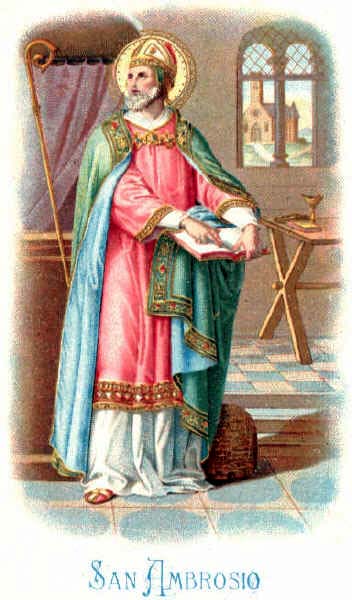
Torna l'appuntamento settimanale, volto alla scoperta dei nostri cari Santi! Oggi ci soffermiamo su Sant'Ambrogio, il quale ha avuto un peso molto strong in the Catholic Church, thanks to his wisdom and courage with which he defended the rights before the Empire. He also had a positive influence on St. Augustine of Hippo before his conversion powerful.
then discover the history of St. Ambrose through the usual biographical section, followed by some of his holy thoughts drawn from his most Remember:
memory of Saint Ambrose is mandatory for the whole Church, under the new calendar, and is particularly solemn in Milan, on this day that honors his great patron and beloved Bishop.
Ambrose was born in Milan, but in Trier in Gaul, to the 339. He was the son of an official Roman in service beyond the Alps, and after the death of his father the family returned to Rome. Ambrose studied law and rhetoric, and began the legal career.
He was in Milan, when the bishop died, and a good imperial official, who had tried to avoid those disorders often caused by turbulent ecclesiastical elections. He spoke with wisdom and firmness in the assemblies of the faithful, because everything was done according to their conscience and respect for freedom. It was a result of these speeches that his judgments by a cry arose, "Bishop Ambrose."
Ambrose, who was in that assembly as an imperial official, was not even named, being only a catechumen. Surprised and even scared, then proclaimed his unworthiness, professed himself a sinner, even tried to escape. All was useless.
well received baptism, and immediately after the consecration of bishops. "Without the courts and by the public - say the new bishop - to switch to the episcopate, I had to begin to teach what I had never learned." He therefore gave to the reading of sacred books, then studied the Church Fathers and Doctors, such as would have been included too, along with a young orator who, after ten years, he would have baptized: Augustine Tagaste. Ambrose's work was so vast, deep and important, which can hardly be described. Suffice it to say that it was considered almost a second pope, in a time when there were some great figures of the Church bishops.
But Ambrose appeared higher than for all his apostolic work, though it was small and delicate in body how big in spirit.
He, who came from the career of imperial dignitaries, argued before the emperor, not only the rights of the Church, but the authority of her pastors. "They are the bishops who must judge the laity, not the other way," he said, and put among the laity, first, the emperor. Another former
highest imperial official was: "The Emperor and the Church, not above the Church." It took the contingencies Ambrose to apply the utmost in respect and intolerant of the great Emperor Theodosius.
When Theodosius, following the killing of the commander of the garrison of Thessalonica, he slay - or so they said - 7000 innocent people, the Bishop not only rebuked the massacre, but bade a public penance. Theodosius tried to resist. Finally yielded. New David, did penance from October to Christmas. Ambrosian
The iconography was so pleased to be driving away from the threshold of St. Ambrose Cathedral, the Emperor public sinner: in reality the action of the Bishop took place via letters and intermediaries, but the gesture is equally significant, indicating that neither crown man scepter nor exempt from moral law, equal for all, and whose courts are authoritative only God's ministers and pastors of souls. Source: Archives Parish
***
''From''Letters of St. Ambrose, bishop.
Then there is a river that flows like a river over his saints. Anyone who has received the fullness of this river, as the Evangelist John, like Peter and Paul, raises his voice, and how the apostles spread the word of preaching the Gospel with joyful tidings to the ends of the earth, so this river begins to proclaim the Lord. Therefore receive it from Christ, so that your voice is heard. Collect the water of Christ, that water that praises the Lord. Pick from several places the water drop clouds of the prophets. Who collects water from the mountains and conveys it toward you, or draws on sources, he too, like the clouds, poured on others. Then filled to the bottom of your soul, because your soil to be watered and watered by their sources. It fills the reader a lot and gets a sense of what he reads, and who was filled with water can others. The Scripture says,''If clouds are full of water, spilling over the earth.'' (Eccles 11:3).
From treatise "On mysteries" of St. Ambrose, bishop
What you saw in the baptistery? The water of course, but it is not alone: \u200b\u200bthere were the Levites who served and the high priest who questioned and consecrated. Before anything else, the Apostle taught that you do not have to "fix our eyes on things seen, but to the invisible hand are eternal" (2 Cor 4, 18). And again, you read that "the world's creation onward, the invisible things of God can be provided with the understanding in the work done by him, as his eternal power and divinity" (Rom. 1, 20) is recognized through its work. Therefore the Lord himself says: "Even if you do not want believe me, believe the works "(Jn 10, 38). I am sure that there is the presence of divinity. Indeed, I believe its aziuone and do not believe in his presence? How could follow the action, if the first not precede the presence? Consider, moreover, how this mystery is very old and prefigured from the beginning of the world. In the beginning, when God fecxe heaven and earth "I Spirit," the text says, "hovered over the waters" (Gen 1, 2). Maybe it was not acting that hovered? recognized that it was in action when they built the world while you idce the Prophet: "By the word of the Lord were the heavens made by the breath of his mouth all their host" (Ps. 32, 6). The testimony profetica sono appoggiate ambedue le cose: che aleggiava e che operava. Che alegiasse lo dice Mosé, che operasse lo attesta Davide. Ecco un'altra testimonianza. Ogni uomo era corrotto a causa dei suoi peccati. E soggiunge: "Il mio spirito non resterà sempre nell'uomo, perché egli é carne" (Gn 6, 3). Con ciò Dio dimostra che con l'immondezza della carne e con la macchia di una colpa assai grave la grazia spirituale si allontana. Così Dio, volendo ristabilire quello che aveva dato, fece venire il diluvio e ingiunse a Noé, giusto, di salire nell'arca. Cessando il diluvio prima mandò fuori il corvo, in un secondo tempo fece uscire la colomba, la quale, a quanto si legge, ritornò con un ramo d'olivo. Tu vedi water, you see the ark, you look at the dove, and I doubt the mystery? Water is one in which the meat is immersed for it to be washed every sin. In it is all buried shame. Wood is one to which was affixed when the Lord Jesus suffered for us. The dove is the figure in which the Holy Spirit descended, as you learned in the New Testament, the Holy Spirit in the soul that inspires peace and tranquility to the mind. (Nos. 8-11; SC 25a, 158-160)


0 comments:
Post a Comment